Simplifying a Real-Estate Investment UX
Redesigning the wallet and trading experience for Chile’s leading real-estate tokenization platform.

Reity allows anyone to invest in tokenized real estate. But managing funds and trading tokens still created friction: repeated payments, confusing flows, and unclear market signals.
I redesigned two key parts of the platform — Direct Wallet Deposit and Secondary Market 2.0 — to give users smoother fund management, clearer financial insights, and a simplified selling experience.
Two high-impact projects reshaped how users move money and trade tokens:
Let users preload money into a Reity wallet so they can buy multiple tokens without repeating payments.
Redesign the secondary market experience so buyers and sellers get clearer, actionable information and the platform reduces cash pressure from buybacks.
Both projects were shaped and scoped using Basecamp’s Shape Up method: short pitches, fixed appetites, clearly called-out rabbit holes, and tight success criteria. The work focused on reducing friction, aligning expectations, and protecting Reity’s cash flow.
Problem
Buying across multiple tokens required multiple transactions — slow, confusing, and conversion-killing. By already having a wallet feature, users assumed they could add money to it and then invest at will, but Reity didn’t support this yet. Buying tokens across multiple projects required multiple payments, making the investment process slow, confusing, and conversion-killing.
On the other hand, token buyers weren’t getting enough financial context when evaluating listed tokens, and sellers didn’t know how long their tokens would take to sell. To reduce the negative impact Reity was absorbing unnecessary liquidity pressure by offering buybacks, but better market signals and UX could reduce that cash pressure and set clearer expectations for users.
My Role
As the Product Designer working on these initiatives (collaborating with the CEO, engineers, and legal), I shaped the UX, flows, prototypes, and the handoff artifacts used by engineers. I framed the user journeys, designed the UI patterns, and translated the Shape Up pitches into deliverables.
Process
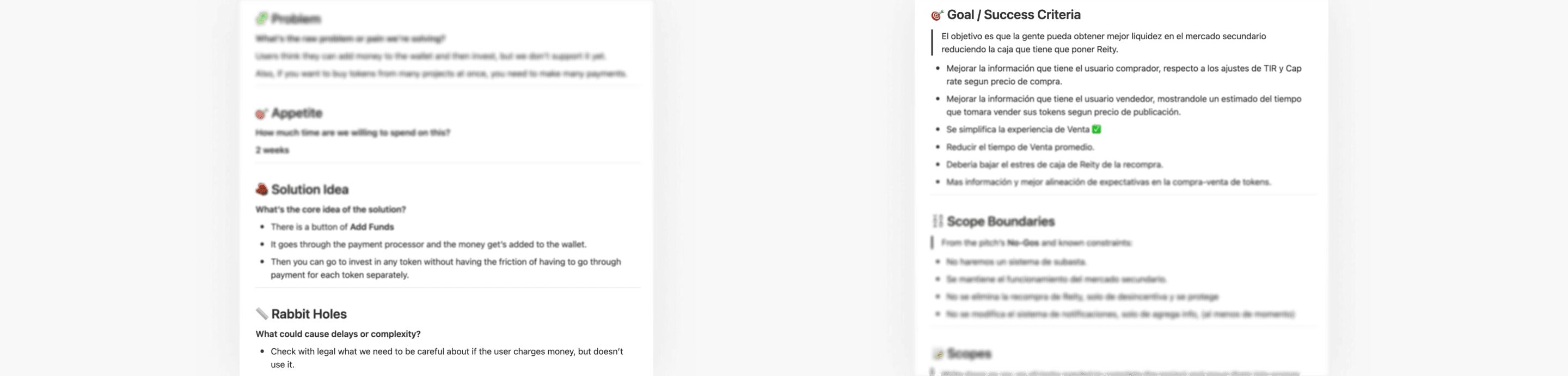
Shape Up framing
For each project we captured:
Problem statement (what’s broken or missing)
Appetite (timebox to limit complexity)
Solution idea (the simplest meaningful thing to build)
Rabbit holes (risks or legal & technical unknowns)
No-go's (what we are explicitly not doing)
Scopes (tasks needed to complete the project)
Success criteria (how we measure if the pitch worked)
This allowed us to ship focused increments: a 2-week scoped Direct Wallet Deposit and a broader, multi-scope Secondary Market redesign.
Key UX Decisions
→ Direct Wallet Deposit
A smarter way to manage funds for faster investments.
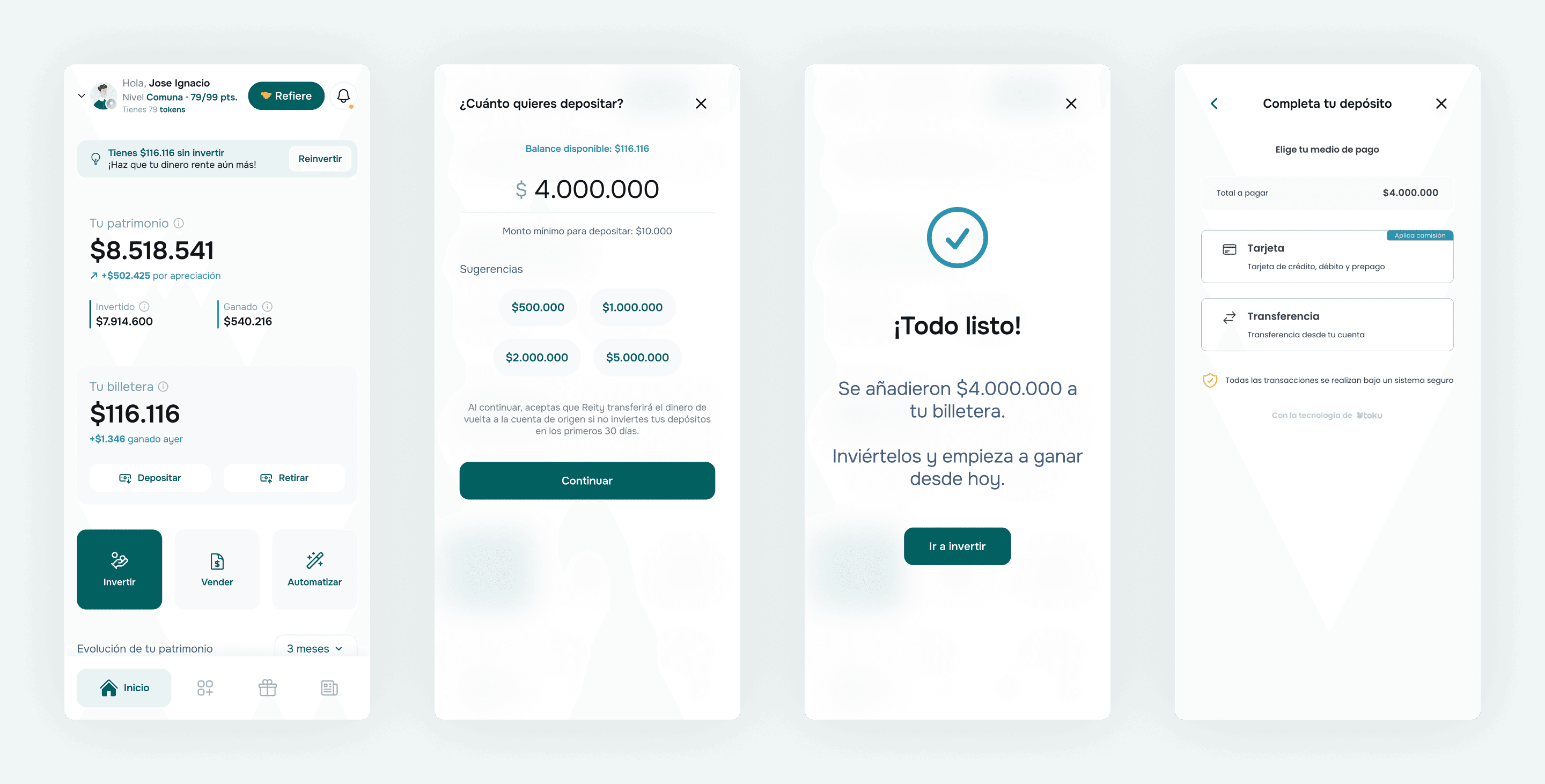
Users need an “Add Funds” flow so they can preload cash into a Reity wallet and invest across multiple tokens without redoing payments for each purchase:
Add a simple “Add Funds” button inside Wallet
Show data-based deposit amount suggestions
Route through existing payment processor
Credit the wallet instantly
Shortcut to “Invest now” after deposit
Error & edge case states for incomplete payments
→ Secondary Market 2.0
A more honest, transparent, liquidity-friendly marketplace.
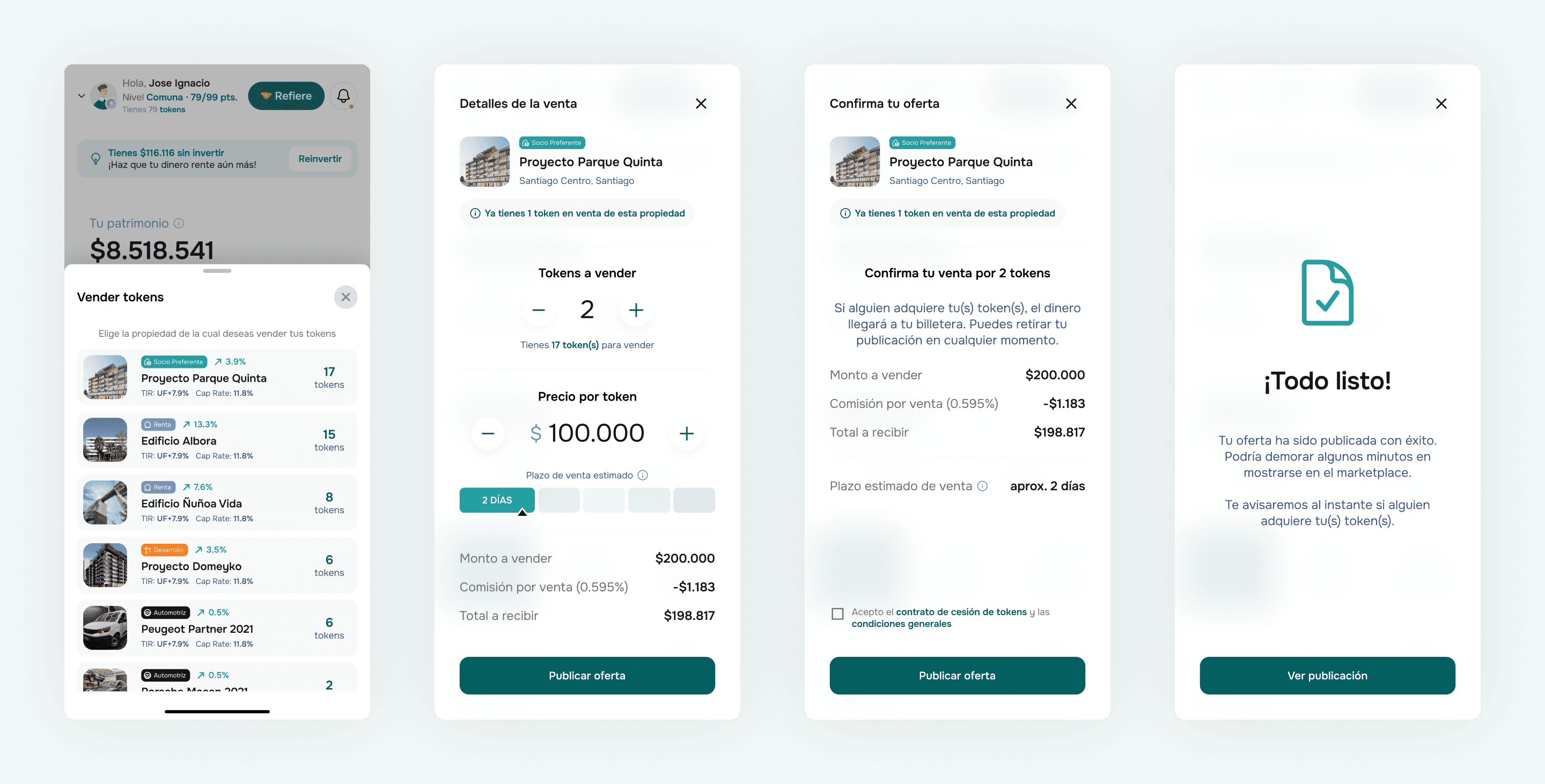
To help sellers avoid unrealistic pricing and reduce unnecessary buybacks, I built a new token-selling flow where:
Users can offer more than one token at a time
Sellers see a realistic estimated time-to-sell
Sell flow is radically simplified
Buyers see adjusted TIR and cap rate based on listing price
Testing & Collaboration
Figma prototypes validated with CEO + engineers
Backend contract for yield formulas + time-to-sell models
Integration testing in staging — verifying calculations, cards, and flow interactions
Legal review for wallet funds handling
Impact
Enabling users to manage their funds inside Reity and invest without repeating payments lowered friction for multiple token purchases, which translated into less payment transactions and faster investments.
Also, improving information transparency for buyers and sellers on the secondary market now allows buyers to make better-informed decisions and sellers list at more realistic prices, reducing confusion to almost having no questions related to selling on Reity's support channels.
Final thoughts
Working with Shape Up helped the team ship two meaningful projects in a short time without getting trapped in potential rabbit holes. Shaping scopes upfront forced focus on the most valuable things: add funds, simplify selling, and reinforce transparency.
These two projects also gave me a better understanding of financial UX in a tokenized environment:
Liquidity problems are often UX problems and can be sorted without adding friction or causing major detraction.
Transparency and trust are the most powerful elements when designing for finance.
Small improvements for can actually produce big behavioral changes for the better.
Trying new ways of working like Shape Up can truly help the team to stay focused, productive, and aligned.
